


Consider the following: A soldier is much more effective with both Spear and Shield working in harmony than independently. There is greater success to be found in both combined.
The life sciences sector is currently navigating a period of unprecedented transformation. The complexity of launching a medical device has reached an all-time high. The traditional “siloed” model, where marketing creates the messaging, content, and collateral and sales executes learn to recite the (often features and benefits-based) “pitch,” is no longer just inefficient; it is a primary driver of launch failure. One recent survey of the life sciences sector found that only 34% of respondents felt that their sales and marketing teams were well-aligned on goals, objectives, and processes.
And research from Gartner indicates that 75% of the highest-growth companies have transitioned to a Revenue Operations (RevOps) model, specifically to bridge this gap between sales and marketing. In the highly regulated world of medical devices, this alignment is the difference between capturing a market and becoming a case study in missed opportunities.
What Does the Lack of Sales and Marketing Alignment Actually Cost Life Sciences Companies?
The financial implications of friction in sales and marketing alignment are staggering. According to Forrester’s Sales and Marketing Alignment Survey, misalignment costs businesses an estimated $1 trillion in recent years. In the MedTech space, where clinical trials and R&D costs are immense, these losses are magnified by the “ticking clock” of patent lives, regulatory windows, and end-user patient immediate needs.
Conversely, data suggests that companies with strong internal team alignment achieve a 20% annual growth rate. For a new medical device launch, the first six months are critical; Roughly two-thirds of new products fail to meet pre-launch consensus sales expectations in their first year.
The bottom line? If sales and marketing are not reading from the same playbook, the device often enters the market with a “value proposition” that resonates in a boardroom but fails on the hospital floor.
Navigating the Evolving MedTech Buying Landscape
The modern medical device buying cycle is not a linear path but a complex web. Today, a typical purchase involves between 5 and 12 stakeholders, including hidden influencers. These stakeholders typically include:
- Clinical Users: Surgeons and nurses focused on efficacy, ease of use, and patient outcomes.
- Technical Evaluators: Biomedical engineers assessing integration and IT security.
- Economic Buyers: Hospital CFOs and Value Analysis Committees (VACs) looking at ROI and Total Cost of Ownership (TCO).
Because these stakeholders have competing priorities, Marketing must provide the evidence-based content that Sales needs to navigate these long cycles (often 6 to 18 months). When alignment is absent, Marketing may focus on “innovative features” while Sales is being grilled by a VAC on “reimbursement codes” and “operational throughput.”
Implementing Sales and Marketing Alignment Strategy: Change the Mindset of Your Situational Positioning.
To bridge this gap, leading life sciences organizations should adopt a situational mapping framework focused on 5 key areas to move beyond basic lead tracking and focus on the qualitative reality of an account:
- Urgency to change
- Complexity of the Decision Process
- Consensus about the Problem
- Competitive Position
- Length of Decision Process
In any medical device product launch, this situational strategy allows both Sales and Marketing to assess the viability of an opportunity. By using this framework, Marketing can tailor content and Sales can tailor their approach based on the specific “snapshot” of a target hospital or IDN (Integrated Delivery Network).
Urgency to Change
Is the hospital facing a “burning platform”? For example, is a high rate of Hospital-Acquired Infections (HAIs) forcing them to look at your new antimicrobial catheter?
Alignment Point: If the “Urgency” score is low, this is further proof that Marketing shouldn’t just produce “Product Features & Benefits” brochures; they need to focus on “Cost of Inaction” insights (such as white papers and blog content) to help Sales create a sense of urgency at the top of the sales funnel.
Complexity of the Decision Process
Medical device sales often stall in the “middle” of the funnel. The situational strategy forces teams to map out the legal, regulatory, and clinical hurdles.
Alignment Point: Marketing can develop “Procurement Guides” or “Implementation Roadmaps” to help Sales demystify the process for the customer and help guide decision-making criteria.
Consensus About the Problem
Does the surgeon want the device (patient outcomes focus) while the CFO thinks the current solution is “good enough” (cost focus)?
Alignment Point: Without consensus, Sales needs Marketing to create “stakeholder-specific value propositions” that bridge the gap between clinical outcomes and financial health.
Competitive Position
How does the new device stack up against the incumbent?
Alignment Point: Marketing provides the “Competitive Battlecards,” but Sales provides the “real-world feedback” from the field to ensure those battlecards are grounded in real conversations, not just generic spec sheets.
Length of the Decision Process
A launch target that expects a 3-month turnaround when the hospital’s average is 12 months is a recipe for missed quotas.
Alignment Point: Shared CRM data and expected pipeline stage milestones allow for realistic sales forecasting, preventing the “blame game” when targets aren’t hit in the first quarter.
Breaking the Silos: Data-Driven Synergy
Gartner’s 2026 predictions highlight that “Ambient Smart Devices” and “Agentic AI” are redefining how HCPs (Healthcare Professionals) interact with brands. In this environment, Marketing must act as the “Intelligence Hub” for Sales.
The Content Trap
A common symptom of misalignment is the “Content Gap.” Research shows that 60% to 70% of B2B marketing content goes unused by sales teams. Why? Because it doesn’t solve the problems identified in the situational strategy. When Marketing and Sales align on targets, content is built to truly be “Sales-Ready.”
Shared Metrics and KPIs
True alignment requires moving away from “Marketing Qualified Leads” (MQLs) as the primary metric. MQL can be a useful engagement data point- both at the individual and account level- but they are no longer the Holy Grail of the marketing and sales process they once were perceived to be. Instead, life science organizations should focus on:
- Pipeline Velocity: How quickly are accounts moving through the stages of the sales pipeline? Where are deals stalling or falling out?
- Win Rate by Primary Stakeholder and Total Stakeholder Involvement: Are we winning with surgeons but losing at the VAC level? What is the win rate when 3 or more stakeholders are identified and engaged? Note: Engaging three or more stakeholders in a B2B deal increases win rates by 2.4x to 2.5x compared to engaging just one.
- Content Correlation vs. Attribution: Is there clear evidence of which marketing content and consumption actually helped Sales close the deal? While the temptation can be to try and find that “one thing” (and then replicate it elsewhere), in complex Life Sciences deals that (a) take 6-18 months to close and (b) involve 5 to 12 stakeholders and influencers, chasing direct attribution and causation is most often a fool’s errand. The focus should be on collaborative correlation of quality content and frequency of engagement. Much top-of-funnel content that is effective can mistakenly get turned off or ignored simply because the CRM or marketing automation software cannot directly track its path and contribution.
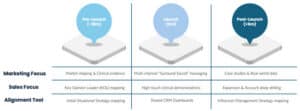
Practical Application: Implementing your Situational strategy – The Launch Roadmap
For a successful medical device launch, the alignment should begin 18 months before FDA or MDR approval.
Sales and Marketing Alignment: The Spear and the Shield
In today’s life sciences market, a “good” medical device is simply no longer enough. The market is too crowded, and the buyers are more sophisticated than previously experienced while conducting independent, anonymous research of vendor options well before ever making themselves known. Most B2B buyers are evaluating 4 to 5 companies on average, and once that short list is identified, a clear early favorite typically emerges.
Success in such a noisy, competitive environment requires a unified front where marketing goals (brand authority, lead quality, multi-stakeholder engagement, and evidence dissemination) are perfectly calibrated with sales targets (win rates, quota attainment, account penetration, and deal velocity/cycle reduction).
By implementing simple, scalable situational strategy frameworks, organizations can move past the “us vs. them” mentality. When Sales and Marketing look at the same “snapshot” of a customer, they stop focusing on only lead volume and quality and start collaborating on how to solve the customer’s most pressing clinical and economic challenges in truly differentiated, value-added ways. Sales and marketing alignment is not just a management buzzword; it can become the most potent competitive advantage in an organization’s arsenal.